Represents a loop predicate that iterates over instances of a predicate. More...
#include <pred.hpp>
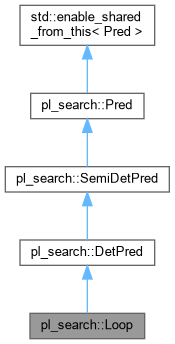
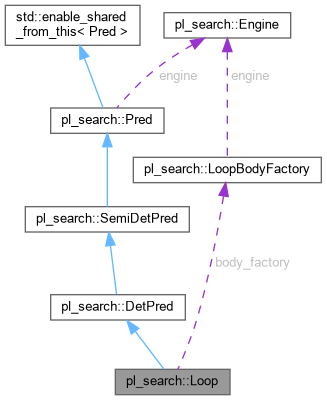
Public Member Functions | |
| Loop (Trail *trail, LoopBodyFactoryPtr bf) | |
| Constructs a predicate that loops over (instances of) a predicate while loop_continues() is true. | |
| Loop (Trail *trail, LoopBodyFactoryPtr bf, int depth) | |
| bool | call () override |
| Calls the Loop predicate. | |
 Public Member Functions inherited from pl_search::Pred Public Member Functions inherited from pl_search::Pred | |
| Pred (Trail *trail) | |
| Default constructor. | |
| PredPtr | get_continuation () |
| Gets the continuation of the predicate. | |
| virtual void | set_continuation (PredPtr cont) |
| Sets the continuation of the predicate. | |
| PredPtr | last_pred () |
| Follows the continuation chain to the last predicate. | |
| virtual void | call_init () |
| Initialize call. | |
| bool | call_continuation () |
| Calls the continuation of the predicate - first call_init and then call. | |
| virtual | ~Pred ()=default |
| Virtual destructor for proper cleanup. | |
| virtual std::string | get_name () |
| For debugging. | |
Public Attributes | |
| LoopBodyFactoryPtr | body_factory |
Protected Attributes | |
| int | depth |
| Protected Attributes inherited from pl_search::Pred | |
| PredPtr | continuation |
| The continuation of the predicate. | |
| Trail * | trail |
| Pointer to the trail for managing variable bindings. | |
Detailed Description
Represents a loop predicate that iterates over instances of a predicate.
Loop is a predicate that loops over (instances of) a predicate. It is similar the following recursive Prolog code template:
loop(State1, Depth) :- loop_continues(State1, Depth), !, body_call(State1, State2, Depth), NextDepth is Depth + 1, loop(State2, NextDepth).
loop(_, _).
The constructor takes a pointer to a subclass of LoopBodyFactory that is used to generate body predicates to call and to test if the loop should continue. It is essentially the body_call(State1, State2, Depth), NextDepth is Depth + 1, loop(State2, NextDepth) part of the Prolog code template. The continuation of the loop predicate is initially the predicate to call after the loop body. When the loop body predicate is called a new body predicate is generated as well as a new loop predicate. The continuation for the body predicate is set to the new loop predicate and the continuation for the new loop predicate is set to the original continuation.
Constructor & Destructor Documentation
◆ Loop() [1/2]
|
inline |
Constructs a predicate that loops over (instances of) a predicate while loop_continues() is true.
- Parameters
-
trail Pointer to the trail. bf a pointer to a subclass of LoopBodyFactory that is used to generate body predicates to call and to test if the loop should continue.
◆ Loop() [2/2]
|
inline |
Member Function Documentation
◆ call()
|
overridevirtual |
Calls the Loop predicate.
- Returns
- True if the loop terminates and the continuation succeeds or if the "recursive" call to the loop predicate succeeds, false otherwise.
Loop is similar to the following recursive Prolog code template:
loop(State1, Depth) :- % recursive case - loop continues loop_continues(State1, Depth), !, body_call(State1, State2, Depth), NextDepth is Depth + 1, loop(State2, NextDepth). loop(_, _). % base case - loop terminates
Note: loop_continues() must not bind any variables - it should be a pure test of the current state. In the Prolog code above loop_continues is allowed to bind variables that can be used in body_call but this is not allowed in the C++ implementation of Loop. ANy variable bindings needed by the body predicate should be made in the body predicate itself.
Reimplemented from pl_search::Pred.
Member Data Documentation
◆ body_factory
| LoopBodyFactoryPtr pl_search::Loop::body_factory |
◆ depth
|
protected |
The documentation for this class was generated from the following files: